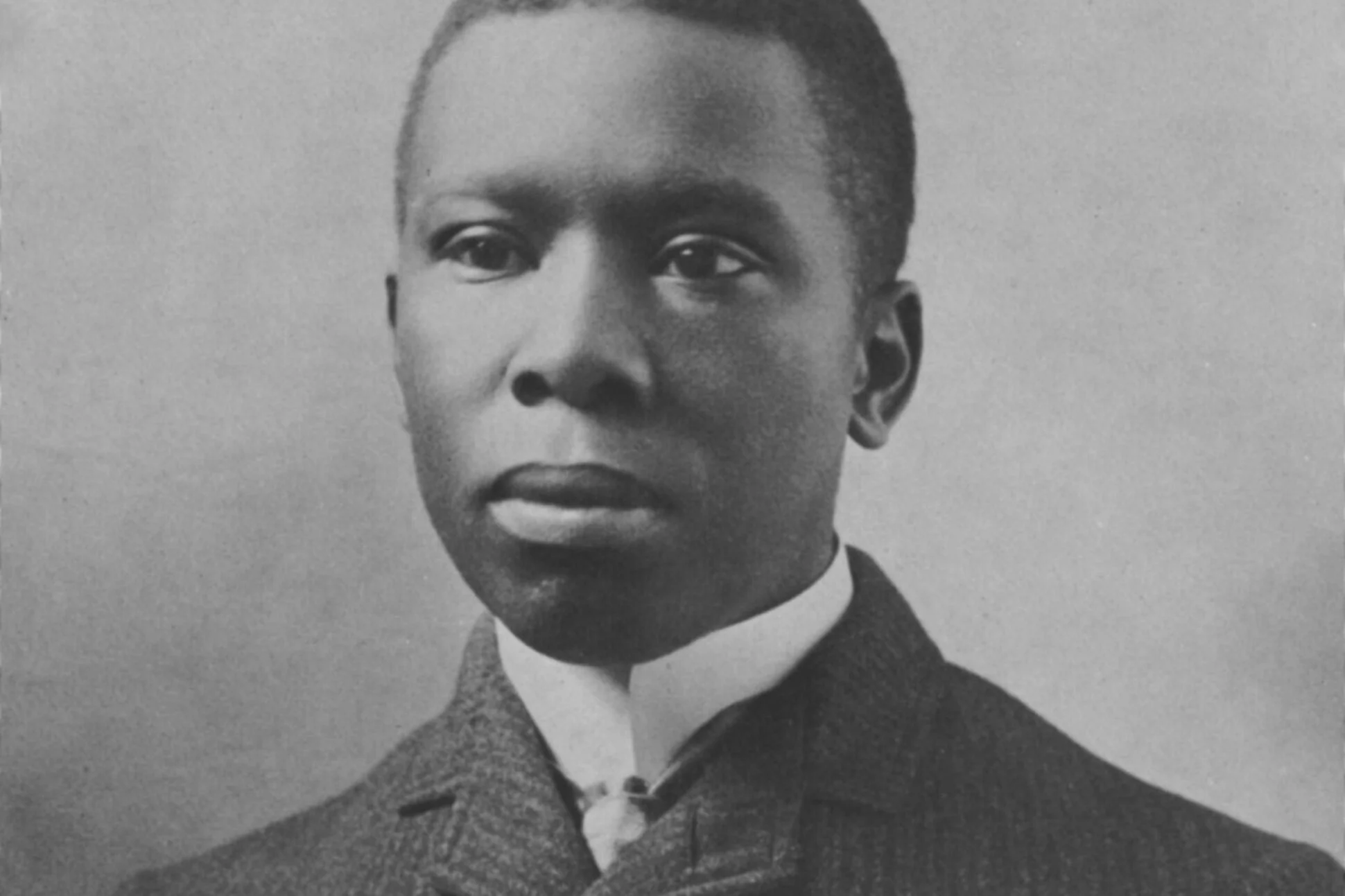
In the 19th century, language and education were some of the principles that connected black folks everywhere. Readers likely relied on local newspapers, much the way we rely on social media and tv shows today. Noting from numerous coverages in local Freetown newspapers in the late 1800s and early 1900s, this small West African country knew and loved the work of the African American Poet, Paul Laurence Dunbar.
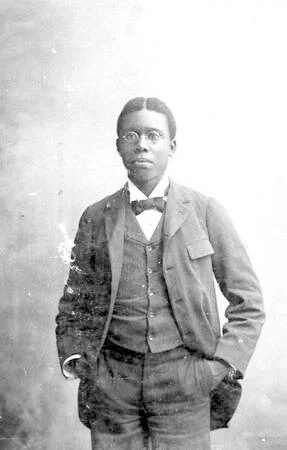
Dunbar, age 19 in 1892
courtesy of Ohio History Central
Dunbar was born in 1872 in Dayton, Ohio to formerly enslaved parents from Kentucky. His Father had fled slavery prior to the Civil War and had served in one of the black regiments. His mother had been emancipated and moved to Ohio with her family. As a first-generation free black American, his positioning into this post-war, post-slavery society was anything but ordinary. The only black American in his high school, Dunbar was selected as Class Poet and had published two poems before graduating. One of his classmates and good friend was Orville Wright of the Wright Brothers, who showed support for Dunbar’s talent, especially when it came to publishing his early poems.
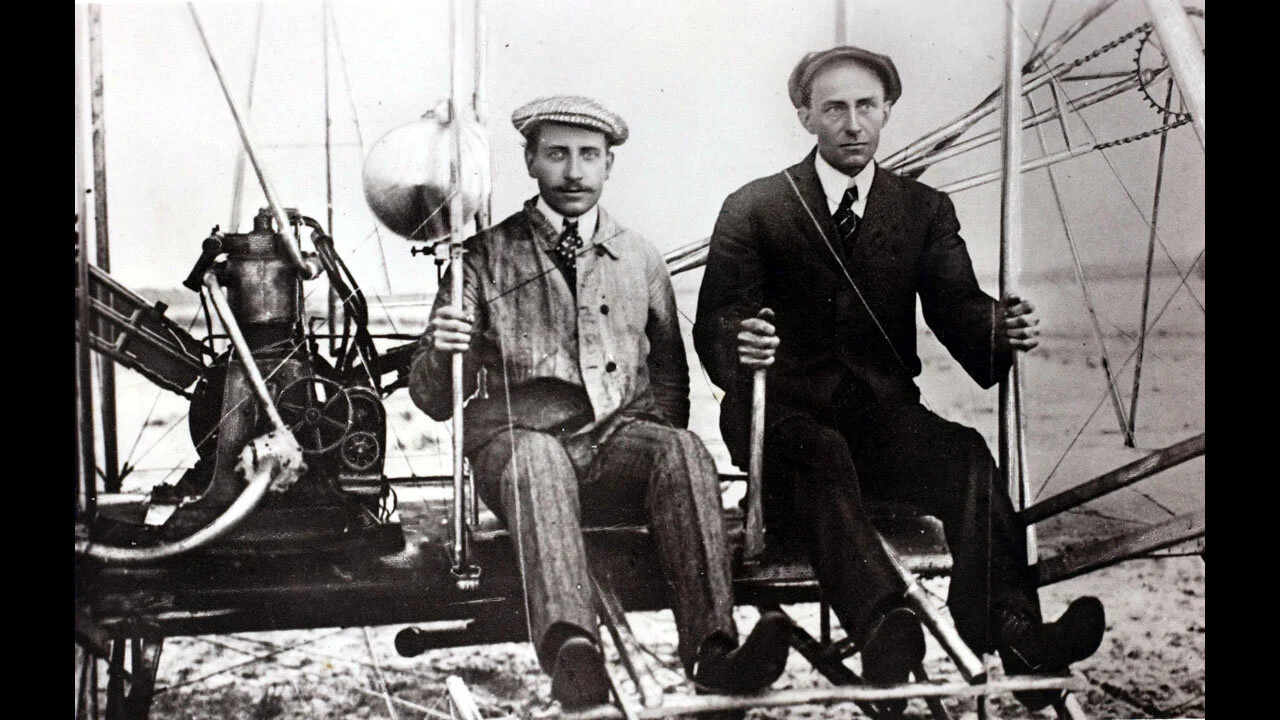
Orville and Wilbur Wright
Built and flew the world’s first successful motor-operated airplane (photo courtesy of CNN)
Freetown, Sierra Leone by 1892 had seen its share of achievements for almost a whole century. There were Freetown photography studios by the 1860s and the colony had produced its first Medical Doctors almost half a century earlier. Also, as mentioned in another blog post, in 1864, 30 years earlier, William Cole, a Lagos Poet, had published a series of poems in the Nigerian Newspaper, Anglo-African.
Laurence Dunbar was one of the first African American Poets to gain national acclaim in America. Others before him, such as Jupiter Hammon, published his first poem in 1761 and Phillis Wheatley, published her book in 1773.
In September of 1897, the Sierra Leone Weekly News featured a spotlight on 25-year-old Dunbar, mentioning his trip to London as well as his recently published book, “Lyrics of Lowly Life”. Later, in December of the same year, the Freetown Newspaper, in its account of the ‘Negro Progress in America’, also mentions Dunbar’s work as evidence of the future of ‘the Negro’.
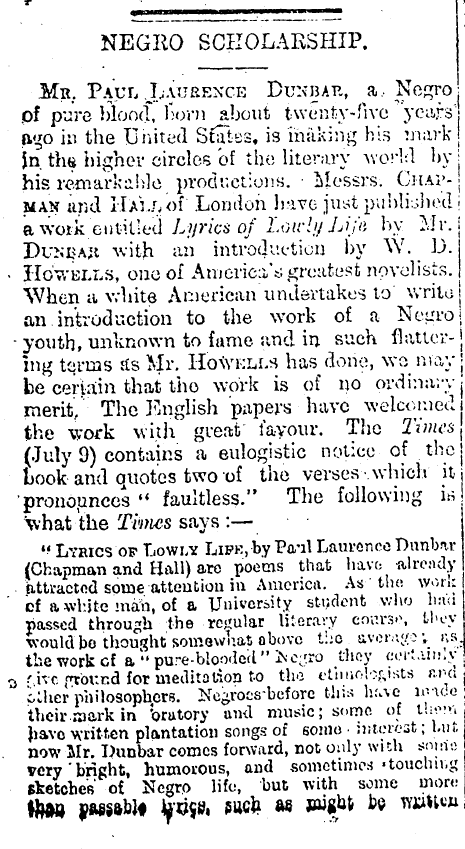
Sierra Leone Weekly News
September, 1897
Besides the fact that in those days, achievements of any black person was an achievement for all blacks everywhere, two key possible reasons come to mind regarding the level of interest Sierra Leone had for Dunbar.
In 1896 or 1897, during his trip to London, 25-year old Dunbar met British-Sierra Leonean Composer, 22-year old Samuel Coleridge-Taylor. Coleridge-Taylor’s mother was British and his father, Daniel P.H. Taylor, a Sierra Leonean of Aku Recaptive parents, had received his Medical degree in London around 1874. While Coleridge-Taylor never visited Sierra Leone, his music compositions, like Dunbar, celebrated the progress of black people. Both were emerging as star models of the global black community. Coleridge-Taylor, who entered the Royal College of Music at the age of 15, had been dubbed the ‘Black Mahler’. For the next few decades, he produced several acclaimed compositions. Dunbar’s works had been praised by the likes of Frederick Douglas and Harper’s Weekly. He would also go on to publish several classic works of Poetry and Novels praised as instrumental in shaping African American literature. The two collaborated on several compositions together. Among their collaborative works, Coleridge-Taylor and Dunbar produced “Dream Lovers” in 1898, a story about a Moroccan Prince. Both gentlemen have schools today in America named after them; the Samuel Coleridge-Taylor Elementary School and Paul Laurence Dunbar High School, both in Baltimore, Maryland.
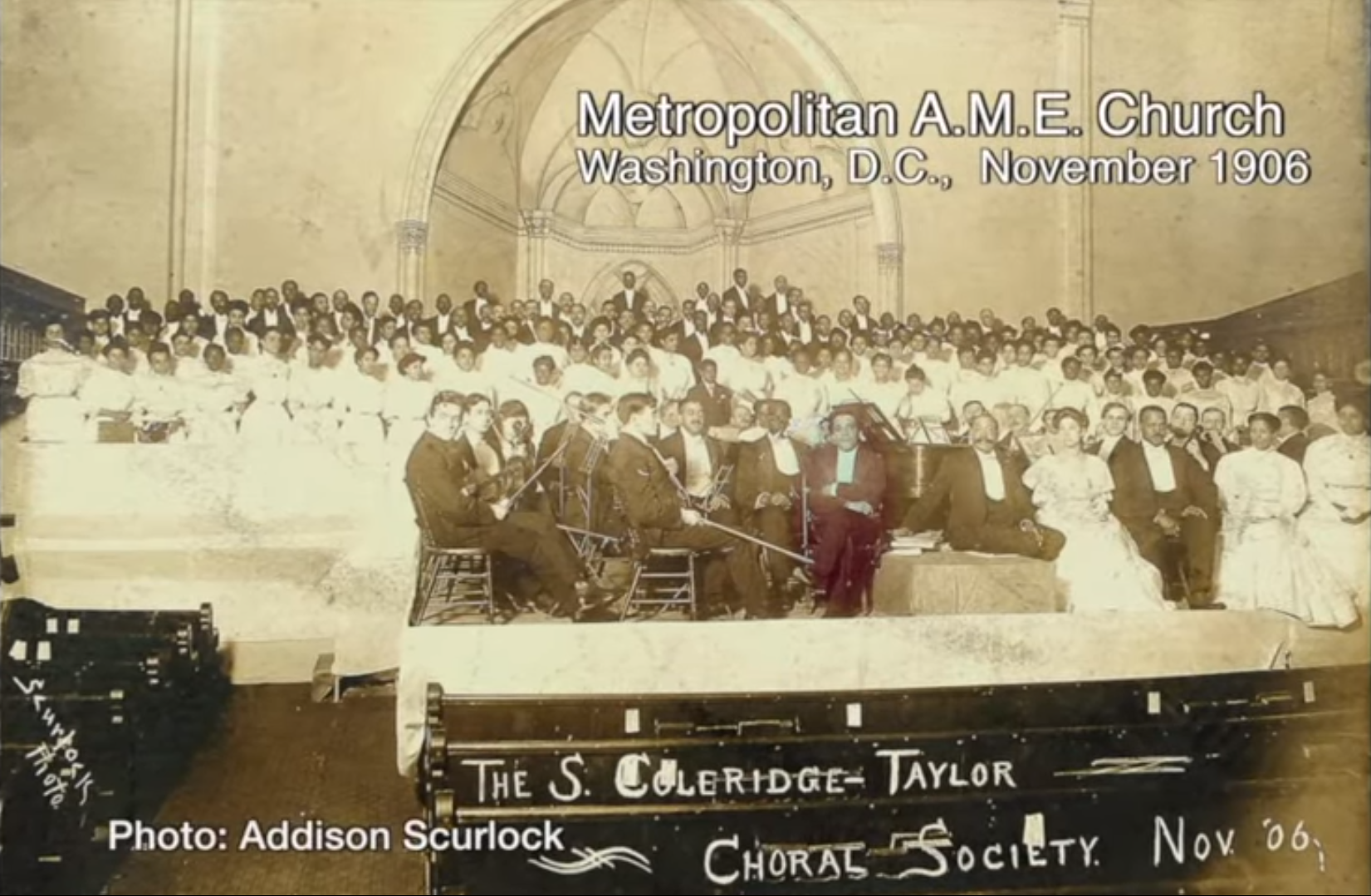
Samuel Coleridge Taylor Choral Society
The British-Sierra Leonean Composer, Samuel Coleridge-Taylor made several tours to America in the early 1900s, leaving his mark across the African American musical community. He inspired the establishment of the Samuel Coleridge-Taylor Choral Society in 1903, in Washington D.C., made up of about 200 African American singers who performed several of his works.
Another possible cause for interest is that one of the writing styles that Dunbar has been celebrated for is his dialect verse. Many of his poems were written in what some call the ‘Negro Dialect’. It was a dialect he was familiar with, having, formerly enslaved parents from southern American plantations. Its usage in poetry and literature by Dunbar and other African American writers of the time such as James Weldon Johnson, demonstrated their efforts to convey deep and real experiences of their people, masked in a seemingly simplistic broken-English. African American speech had never been recognized as a serious language and some Whites often found humor reading it. Dunbar and others however, wrote with substance and great technique, the black experience in brilliantly crafted western poetic styles to convey their messages.
It comes to no surprise that one of the poems highlighted in the Sierra Leone Weekly News announcement of 34-year old Dunbar’s death in March, 1906, was one of his dialect poems, “The Ol’ Tunes”.
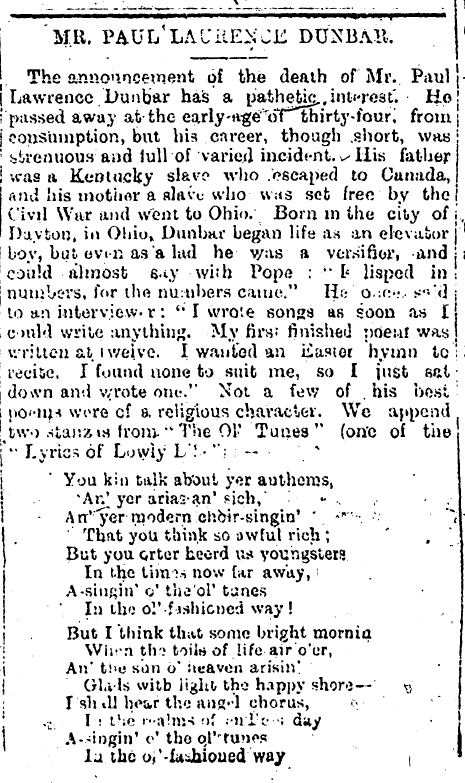
Sierra Leone Weekly News
March, 1906
“The Ol’ Tunes” ~ Dunbar (Excerpt)
You kin talk about yer anthems
An’ yer arias an’ sich,
An’ yer modern choir–singin’
That you think so awful rich;
But you orter heerd us youngsters
In the times now far away,
A–singin’ o’ the ol’ tunes
In the ol’–fashioned way.
There was some of us sung treble
An’ a few of us growled bass,
An’ the tide o’ song flowed smoothly
With its ‘comp’niment o’ grace;
There was spirit in that music,
An’ a kind o’ solemn sway,
A–singin’ o’ the ol’ tunes
In the ol’–fashioned way.
By 1907, the native language of the Creoles of Freetown, Sierra Leone was called Creo (also spelled Creeo), while others called it Patois. The language now known as Krio, owe its origins to the first group of Settlers who established Freetown between 1787 and 1792. These black Settlers were mostly from America and many of them had been enslaved in plantations across the American Colonies. They brought with them their ‘American negro dialect’ and by the late 1800s, this language had been influenced by the language of the Jamaican Settlers in 1800 and the native languages of African Recaptives who were resettled in Freetown between 1807 and the 1860s.
While the American black dialect of Dunbar’s poems and Sierra Leone Creo (Krio) weren’t the same, there would have been enough familiarity for Freetown readers to appreciate Dunbar’s dialect poems, or rather understand them. Another African American Poet, James Ephraim McGirt, born in North Carolina, was also a spotlight in the Sierra Leone Weekly News, years later in 1907. Compared to Dunbar in the newspaper, McGirt is notable for having also written extensively in dialect verse.
That same year, a few months later, a poem by a local anonymous Freetown Poet was featured in the Sierra Leone Weekly News in July 1907, called “For Dear Fatherland”. It was written [or at least an attempt was made to write it] in Freetown patois and the Poet highlighted social issues happening in Freetown. Over the next few weeks, the Poet was commended for choosing to write in the local language instead of English, although the Poet was also criticized for not writing in the language properly.
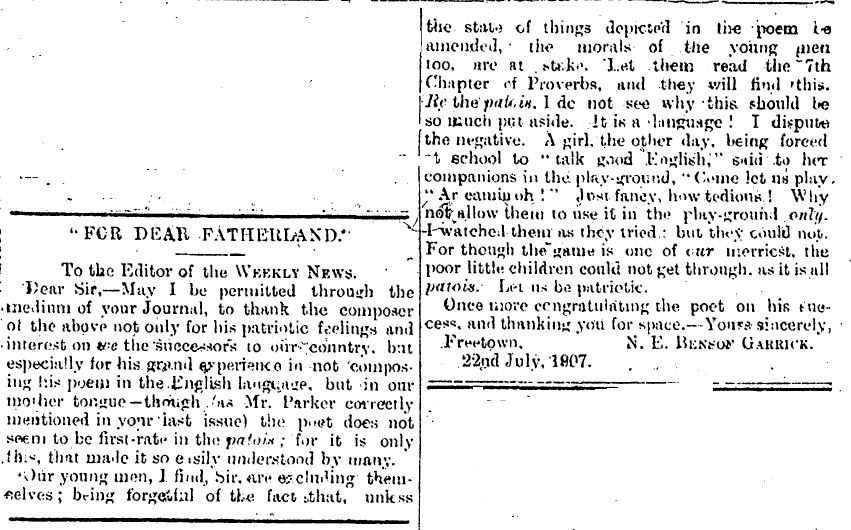
Sierra Leone Weekly News
July, 1907 (a response by N.E. Benson Garrick to the poem published by an anonymous local Poet earlier in the month called “For Dear Fatherland”)
“For Dear Fatherland” (Excerpt)
Whose kind contry dis, me broder,
All man do way tin he lek.
Set down mix and carry mix,
Pick and choose nor day nor way.
But nar one word are go talk
And de word nar true true word.
All man put yase down for yerry;
All man put heart down for think.
By the 1930s, Sierra Leonean local newspapers such as the Daily Guardian had begun publishing more poems and other literature in Krio (spelled Creeo at the time). Well into the 1980s, major efforts were made by Sierra Leonean Linguists and Scholars to develop a standard orthography for Krio. Also in the 1930s, African American Linguists such as Dr. Lorenzo Turner, a North Carolina native, took major steps towards studying African American vernacular. His focus however, was mainly with Gullah-Geechee dialect, the speech of African Americans mainly along coastal North and South Carolina, Georgia, and Florida. In the 1950s, Turner traveled to Sierra Leone, comparing the two languages, Krio and Gullah, finding many similarities between the two.
Other African American Writers continued to write extensively in the Negro Dialect, including Poet Langston Hughes and Writer Toni Morrison. In 1996, Oakland school board formerly acknowledged African American vernacular, which they termed ‘Ebonics’, as an official second language, the first in the nation to do so. However, Linguists still continue to debate whether African American dialect should be considered a formal language nationwide.
What is clear, is that each of these languages have evolved along with the evolving social dynamics of the native speakers. Writers and Poets today, continue to write literature in these languages, echoing their gifted pioneers. Nonetheless, language have always been, and continue to be, a unifying force for Africans and descendants across the Atlantic.
Paul Dunbar, an Ohio native, a first generation free African American, Poet extraordinaire, resonated not just with his African American community, but with blacks in London and in West Africa. Like his good friend Coleridge-Taylor, their mastery of their crafts, one in literature and the other in music, preserved a bridge along the historical black journey and experience that still continues to be upheld.
In Sierra Leone, Dunbar was praised during his lifetime and mourned upon his death, not just for his mastery of western poetics, but his devotion to native dialect and his contributions towards the progress of his people everywhere.
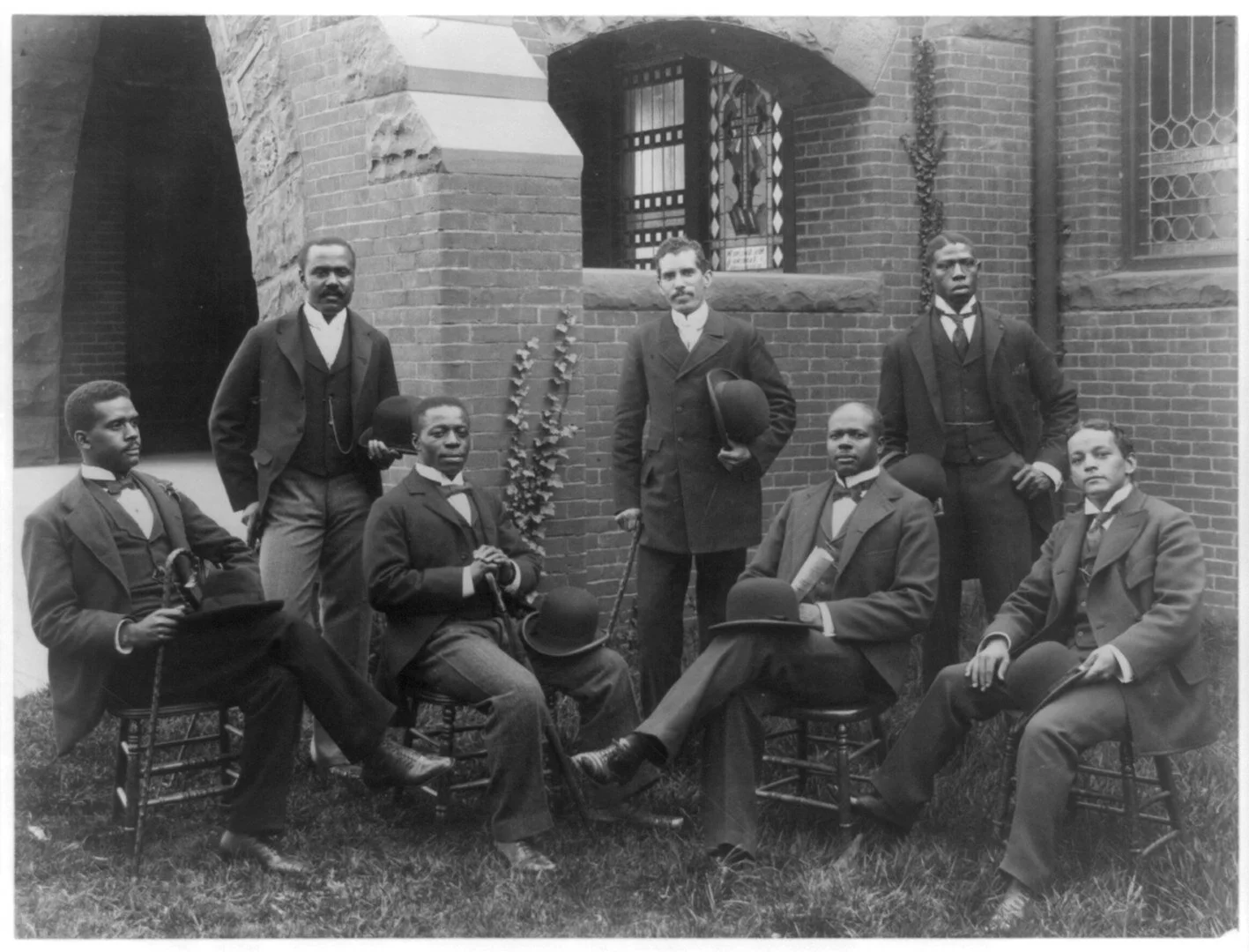
Howard University
1900 Class Picture (courtesy of the Library of Congress)
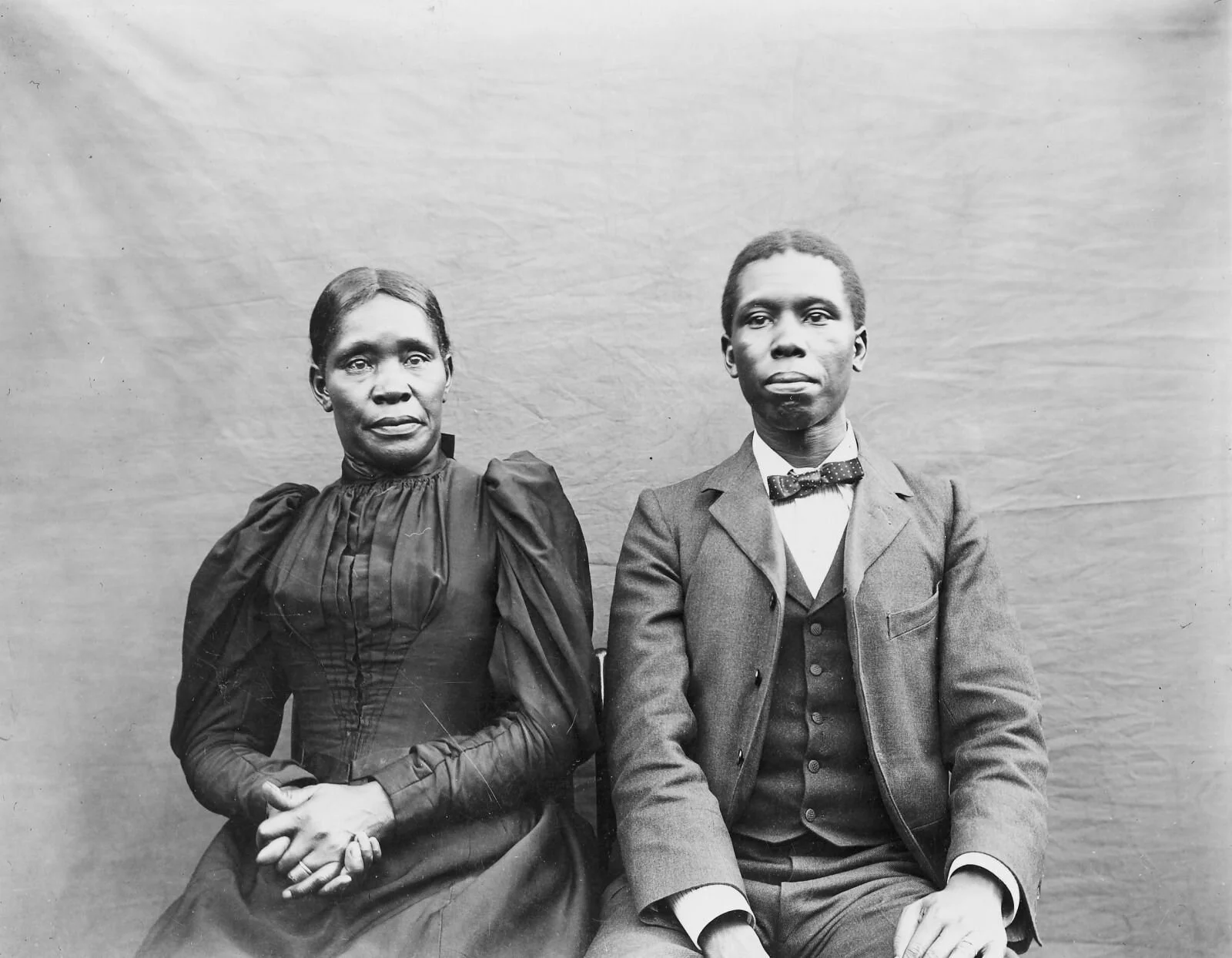
Matilda Dunbar
Paul Laurence Dunbar and his mother, Matilda. An opportunity was provided to Matilda for emigration to Liberia before American slavery ended, though she was emancipated at the end of the Civil War and remained in America, later moving up North to Ohio. She taught her son how to read before he started elementary school.
(Circa 1900, courtesy of the U.S. National Park Service)