1863-1865
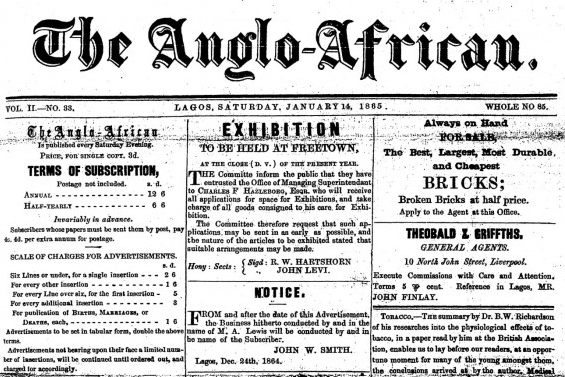
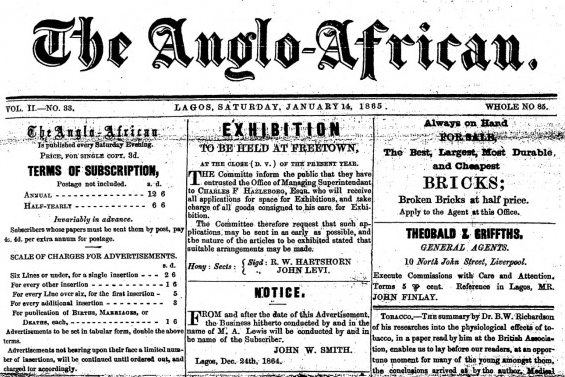
Born in Jamaica, Printer, Robert Campbell led an expedition in the 1850s/60s to West Africa with the African American, Martin Delaney for blacks to settle. Liberia was initially considered, though Campbell ended up in Nigeria in 1862. Soon after, he began publishing the Anglo-African Newspaper.
In the mid 19th Century (1863-65) there was an editorial in Nigeria called “Anglo-African”. It was edited by Robert Campbell, a Jamaican-born Printer and Entrepreneur living in Nigeria at the time. It was apparently Nigeria’s first English Newspaper. Campbell, along with other African Americans such as Martin Delaney, had envisioned establishing a settlement in Egbaland.
Newspaper as a platform during that era was as essential in advocating the rights and demands of the people, as social media and protests have proven today. It was not welcomed by the colonial government who feared the consequences of making such platforms available, especially with anti-colonial sentiments usually expressed in them. The Anglo-African echoed a critique of a Europeanized Africa amidst colonialism. It also touched on local conflicts, such as that between the Oba of Lagos and the Colonial Government, but it largely addressed the colony affairs as well as news from America and the Caribbean. It’s audience was likely made up of an educated elite that included the black intellectual as well as colonial authorities.
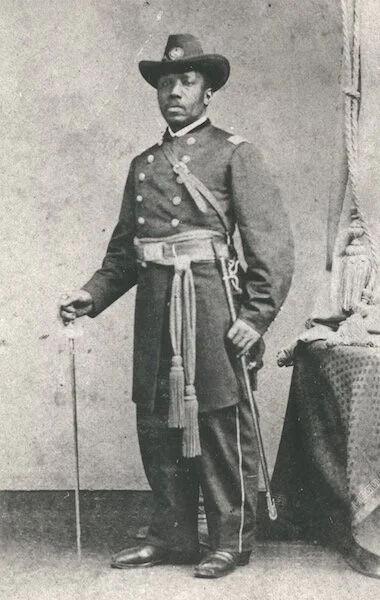
Martin R. Delaney
The first African American field-grade Officer in the United States Army. He worked with Frederick Douglas, the Freedmen’s Bureau, and the American Colonization Society. He was one of the first African Americans to be admitted into Harvard Medical School.
The newspaper published about 24 English poems during its 3 years of existence. Among the poems published were those by William Cowper & James Thomson (English Poets); John Greenleaf Whitter (New England Poet and one of the ‘Fireside’ Poets) & Hannah Gould, both of the latter, American Poets.
A local Poet, William Cole, a Nigerian Civil Servant in Lagos, had about 5 of his poems published there including “Britons Are Not Slaves”, “God Alone Has Power” and “My Little Nell”.
The Africa some know, is one where modern intellectual thought is a mere by-product of western influence. Yet, the fact is that we are contributors to history, not by-products of it.
Throughout time, storytellers who interpret their local experiences and imagination through art, music, or literature, have always existed. Whether in London or Lagos, society will produce its own poets, storytellers, and artists, inspired to express their narratives and interpretations of their experiences and that of those around them.
One of the great things about the creative arts is that we can appreciate a creator’s work and be inspired by their interpretation of the world they see, in any language or form illustrated.
The African always found the necessary instruments to tell their story, such as the old Griots and their Mandinka Kora or others with their Malian Drums to chronicle Africa during the middle-ages. One can then imagine that along with western education and culture, the African would eventually master the craft of storytelling with western instruments as well.
Fewer African Poets, in Africa, could be found during the 19th century, who used the English language and principles of western poetics to tell their story as good as any English Poet. But to assume there was none, or those that could be found were mediocre at best, would be to underestimate the creative genius of the African. The ability of the African Writer to master foreign instruments and use them to express original African experiences, should be given more credit. It demonstrates the African’s ability to generate cross-cultural dialogue, beyond the limitations of language and culture. One can probably find more Africans who have used Western poetics as instruments to deliver an African’s experience, and do it well, than an Englishman or German who can express their original experiences in an African language. Some may argue that writing in dominant languages is the litmus test. This may be so, however, from a context of creativity, the ability to express yourself through methods that aren’t natural to you, could also measure mastery in your craft.
In an article, Nigerian Professor, Michael Echeruo mentioned comparisons of the Nigerian, William Cole’s poem, “Thoughts in Exile”, published in Lagos, around 1864, with “Little Black Boy” published in 1789 by English Poet, William Blake. He noted the conversation between mother and son (in Blake’s poem), and between son, father, and mother (in Cole’s poem). Blake’s poem questioned the slave trade and its conflict with Christian ideals. Echeruo noted others who have suggested that Blake’s poem may have been inspired by Ukawsaw Gronniosaw, an enslaved Bornu-native in London, who wrote “A Narrative of the Most Remarkable Particulars in the Life of James Albert Ukawsaw Gronniosaw” in 1772, supposedly the first published African in Britain. In Cole’s poem, Echeruo suggested influences of Cole’s own life experiences. During that time, this may have included an African William Cole in a British colonized Lagos, likely educated in a heavily westernized Christian missionary-based school and an emerging westernized African culture. While one may read Blake and Cole’s poems and draw comparisons to characters and context, the fact is that Blake was writing of an African’s experience, while Cole wrote of his own African experience.
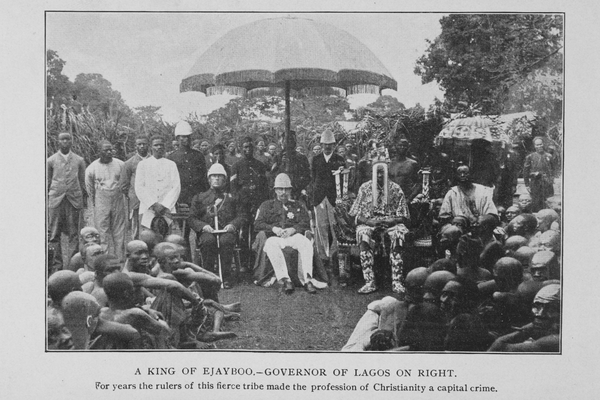
Modern Writers such as Kenya’s Ngugi Wa Thiong’o, have rightly encouraged Africans to write in their own language, as should be the rule. An African, writing African stories in a colonizer’s language is on the one hand viewed from the context of his/her experience of having been colonized. On the other hand, if William Blake had written “The Chimney Sweeper” in Kanuri, or Walt Whitman’s “O Captain, My Captain” in Fanti, I doubt we would view their craft any less than genius. The African Poet, on the other hand, has not only mastered the art of poetry in his native tongue, but has also mastered Western poetics and used it for centuries to write about personal experiences and from his/her original imagination. This is in addition to translating the best of Western literature into the African’s language.
To be a master of one’s own native language is one thing; to be a master of another’s is extraordinary. It's hard these days to find an African, anywhere in the West, who isn’t multilingual. If we are to give much credit to the colonizer for the dominance of his language, surely we should acknowledge the genius in those who aren't native to it, but still manage to master it, and use it to their own benefit.
William Cole’s “Thoughts in Exile” published in the Anglo-African Newspaper, around 1864 in Lagos, Nigeria
I’m sad indeed, yes, very sad,
Whilst others they are gay,
But they have friends around them,
And mine are far away;
But let them have their happiness
Tis foolish to regret,
A time will come, so let me sing,
I may be happy yet.
Tho’ memory brings to mind the past -
The precious days of yore,
When as a child I used to play
Before my father’s door,
And he, good man, with mother too,
Both seated ‘neath the tree
Would smile and call me to his side
Or ‘muse me on his knee;
Then would he tell me how the World
Was rugged, rude, and wide,
And bid me live to be a man,
With conscientious pride;
Then pointed he above him
To realms far thro’ the sky
“My child, thro’ life, do not forget
God and Eternity.”
A few short years, its changes brought,
My grey hair’d sire no more
Was there to sit beneath the tree,
Or watch me ‘fore the door,
My mother, she grew old, infirm,
And I a man became,
And, as I live, I’ll ne’er disgrace
Its honorable name.
I loved but once, and she is dead
I sorrow’d, sigh’d and felt,
The feelings of a broken hearth,
As by her grave I knelt;
But flowers are growing o’er her tomb,
Tho’ she lies cold and deep,
But then how happy must she be,
Whilst I, full sad, must weep!
Then fled to a foreign shore,
Without a friend, without a guide,
I lived to learn, and learnt to live
An exile’s life, where oft they’ve died;
But still my heart feels for the land-
The land I love, and past regret,
Oh! Waft me, Muse, in silent thought,
To yon bright home where first we met.
For 19th Century African Poets like William Cole, European imperialism was seen as the great villain against Africa. The contemporary African Poet or Artist face a different set of challenges. Socioeconomic dilemmas such as poverty and corruption are caused by their own governments and furthered by weakened social structures that prevent progress. Remnants of colonialism also remain an underlying basis of many of Africa’s problems.
William Cole and Ukawsaw Gronniosaw both lived in an era where the source of their oppression was largely foreign. Today, the main source of Africa’s problems are mainly local. It is even more important today, that African experiences are seen and heard through the creative works of all of its storytellers, not just its western educated. It includes the local masses, many of whom have little access to western instruments or the opportunities to learn and master them as tools for self-expression. The poor and marginalized need their voices heard and experiences felt, in the languages and expressions native to them. The world will appreciate their authenticity, knowing that through African Poets like William Cole, there is really nothing more to prove about the creative and intellectual genius of the African in foreign dialogues. Today’s dialogue calls for local expressions that will resonate with the local sources of Africa’s current problems.
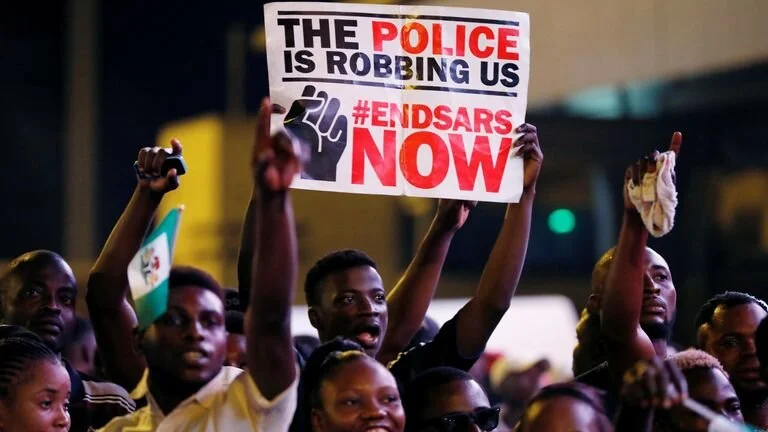
Nigeria 2020
SARS is a branch of the Nigerian Police Force, established in 1992. Thousands in Nigeria and millions around the world are protesting inhumane acts of SARS officials and calling for the end of its authority. (photo courtesy of sky-news)
#EndSars
Reference:
Michael J. C. Echeruo. “Theologizing 'Underneath the Tree': An African ‘Topos’ in Ukawsaw Gronniosaw, William Blake, and William Cole.” Research in African Literatures, vol. 23, no. 4, 1992, pp. 51–58.
ECHERUO, Michael J.C. “‘Anglo-African’ Nigerian Poetry, 1863-1865.” Présence Africaine, no. 153, 1996, pp. 169–188.
Blackett, R. J. M. “Return to the Motherland: Robert Campbell, a Jamaican in Early Colonial Lagos.” Phylon (1960-), vol. 40, no. 4, 1979, pp. 375–386.