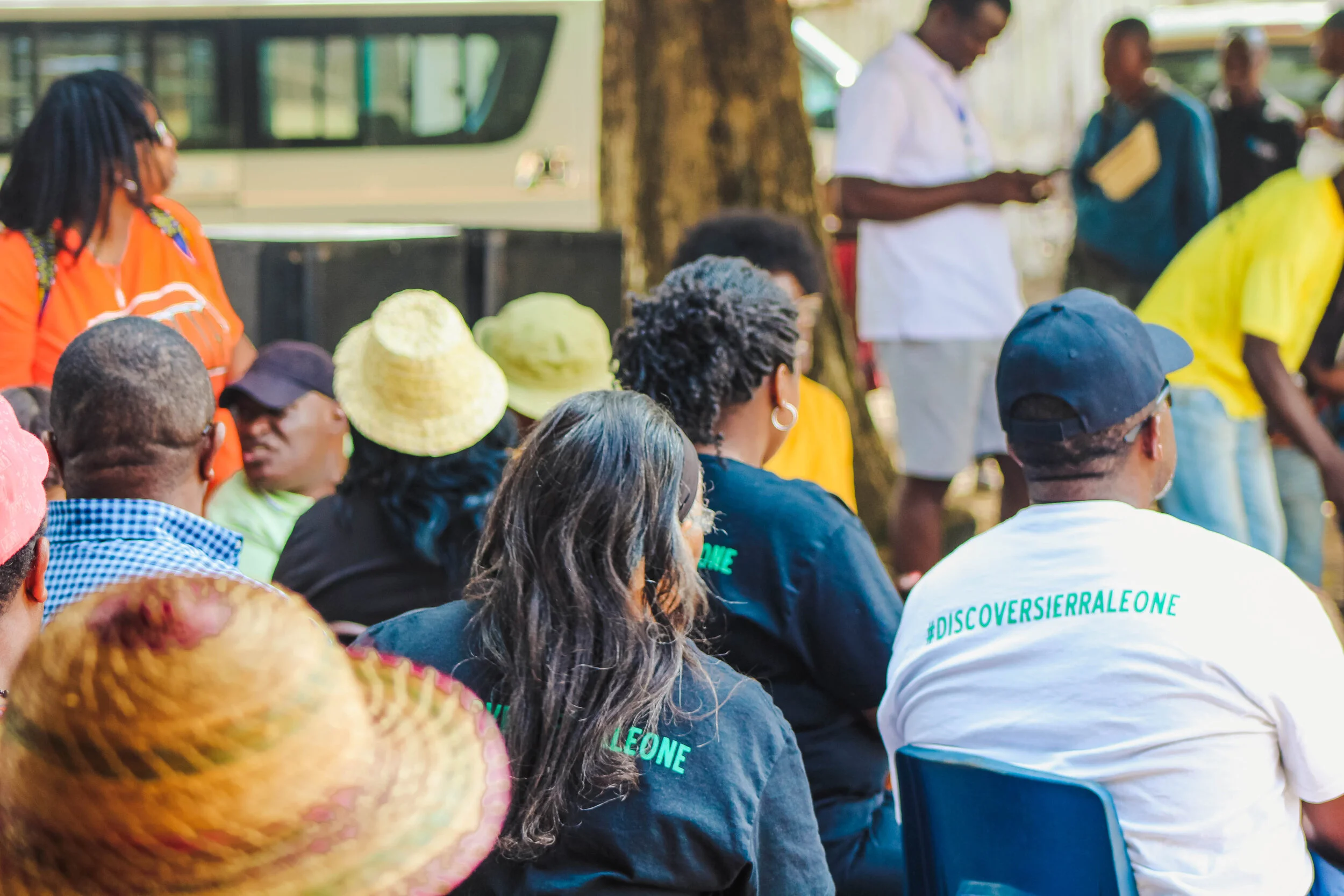
By the time we got to Freetown at the turn of the year, New Year’s Eve, the trip had gotten some buzz in the community and dubbed the largest tour group visit of African Americans to Sierra Leone.
To recap from part I, we touched down in Lungi, made our way to Bunce Island, then off to Makeni, on to Old Yagala in Kabala, up a mountain and back down, then to Rogbonko village where a renowned Gullah Sweetgrass basket maker and a Sierra Leonean Shukublai maker made baskets together, and then into Freetown which kicked off with a New Year's Day tour to Old Fourah Bay College and parts of downtown Freetown was were I left off...
The festive continued that night at the Cape Sierra Lighthouse where folks across the city showed up to see various members of the group perform at the Musical Extravaganza. Auntie Pearlie Sue Anita Singleton-Prather and the Gullah Kinfolk, who've performed several times at the World Bank and across the U.S. made their debut officially in Freetown to a packed house. Also making waves with their amazing performances was the notable Daise Family. If you remember watching "Gullah Gullah Island" back in the day then yes, this is the awesome family Ron, Natalie, daughter Sara, and son Simeon. They sang songs that hit the soul of every Sierra Leonean in the audience. The essence of being connected can sometimes be exemplified through music, from the soul, and they surpassed all expectations! The Relafords, another Gullah family from Georgia chimed in with several renditions of theirs as well, marking a night filled with tune and melody that weren't too far removed from Sierra Leonean melody and tune. Among the audience were Isatu Smith, former dynamic Chairman of the Monuments and Relics Commission, and Parliamentarian Kandeh Yumkella, former Presidential Candidate, among many other distinguished Freetonians.
The next morning, the group made their way to the Sierra Leone National Museum for a Press Conference hosted by the Ministry of Tourism. Each member of the visiting group gave an introduction and one really got a sense of the weight of all the impressive credentials collectively present there; Professors, Doctorates, Scholars, Performers, Actors, Writers, Artists, Commissioners, all there from across the seas, reconnecting to what by that time, had been clear to them, was home. The Minister of Tourism gave a resounding speech in which she welcomed all and presented each as an Ambassador to not only be provided with a gateway to invest in Sierra Leone but to carry our message and brand of peace and an open door to others who may decide to return to Sierra Leone in the future. The Chairman of the Monuments and Relics Commission, Charlie Haffner who is no stranger to the Gullah community as he welcomed them decades ago as a Performer, gave the group a "Sierra Leone Theatre Dramatist" welcome. As everyone delved into the delicious array of Sierra Leonean plassas and rice dishes, Haffner and one of the visiting members, Monica Montgomery, former Executive Director of the Prince George's African American Museum and Cultural Center met to exchange ideas.
The day carried on with a lecture series at the Institute of Public Administration and Management (IPAM) with an amazing panel including Sierra Leonean Botanist, Dr. Cyrus Macfoy, Sierra Leonean Chair of the Department of Health Sciences at South Carolina Coastal University, Dr. Fredanna M’Cormack McGough, Author of “The African American Odyssey of John Kizell”, Kevin Lowther, American Anthropologist, Joseph Opala, and Chair of the Monuments and Relics Commission, Charlie Haffner.
At night the group got ready to attend the prestigious Freetown Mayor’s Ball at the Radisson Blu Hotel. Tickets were sold out so only a few could make it, but the Gullah Kinfolk represented the group well with their attendance and performance at the Ball.
The next day, before the group got ready to travel back out of Freetown, it was only fitting to grace audience and connect with the dynamic Mayor of Freetown as well as members of the Krio Descendants Yunion, a global organization based in Freetown, that preserves and presents the heritage and history of the Krio descendants, the local inhabitants to the city of Freetown. The event was splendid. The Mayor, who had recently signed a ‘Sister City’ with the city of Charleston, South Carolina and established a partnership with the soon to be built International African American Museum in Charleston, expressed her excitement to receive the group officially, to Freetown. The Mayor recounted the fact that she herself, is a descendant of one of the African American Settlers of 1792, David Edmonds. The Gullah language is closely linked to the Krio language, and some Scholars have the similarities of both languages at the top of the list regarding creolized language comparisons. There were certainly very visible similarities between the manners and customs of the Gullah people and the Krios observing both groups in just that short period of exchange at the event. Interestingly, many of the 1,000+ Black Loyalists who settled and established the city of Freetown in 1792 hailed from South Carolina. Mrs. ‘Mammy’ Garber, the respectable leader of KDY and a well positioned leader in the Krio community-at-large also welcomed the group as a customary Awujoh was performed and the Ancestors were deemed as having favored the arrival of the group.
The group, in about 4 buses, departed Freetown for Bo, arriving deep in the night for the next few days of festive and local experiences. The buses drove out to Kenema the next day where like every other corner of Sierra Leone visited so far, were welcomed by traditional performers of the area, this time the Mende. The masqueraders showed out in pure Mende style, as the Gorboi, Sowei, Falui, and others exhibited their cultural dances and expressions to the group. Also highlighted in the performances was ‘Mama Kparah’, which is also known as ‘Moko Jumbie’ in places such as the Caribbean, where the tradition of the stilt walker as a customary performer in festive occasions has been passed down through generations, across the Middle-Passage.
The Echo of a Mende song that was preserved in the Gullah Family, the Morans of Harris-Neck Georgia, brought Wilson Moran back to Sierra Leone this trip as he led the group on one of the final leg of this journey, a trip to Senehun-Ngola, the Mende village where he and his Mother, Mary Moran, Grand-daughter of Amelia Dawley who gave the song notoriety, had first travelled there over 20 years ago. Now the Relafords, a branch of the Moran family were now here for their first time to relive the experience of connecting with known roots and a village they could call home. Senehun welcomed their African American family and the group in grand style.
The last leg of the trip took place in Bo, as Aunty Pearlie Sue, the renowned Gullah Storyteller and Educator, received a crowning as Honorary Paramount Chief in Kori Chiefdom, Moyamba District. This speaks volumes as Aunty Pearlie has been along this journey since 2006 when Fambul Tik took the largest group of Sierra Leoneans at the time, to participate for the first time in the Penn Center annual Gullah Festival. As it was for others such as the Daise family, the Moran family, the Relafords, the Gullah Kinfolk, and all of the amazing members of this group, this journey was more than a trip, it was a circle, a closed circle, a coming full circle, right through the middle-passage, across the seas and back home.
There is so much more about this remarkable journey that transcends mere words and eloquence, but was experienced and will surpass memory and become embedded in the fabric of roots and heritage; it will certainly be preserved and cherished for generations to come.
There is a lot of layers to this journey that couldn’t find space within this summary, but made this journey even more memorable and important.
One of the points of intersection between the sentiments expressed by the African American visitors and the Sierra Leonean participants was hands down, the role of the 12+ Tour guides Students who walked with the group throughout the entire journey. Although current students, their professionalism, hospitality, attention, and commitment to not only showcasing the best of Sierra Leone, but also exhibiting the essence of who we are as Sierra Leoneans was exceptional. There were strong connections made between the visitors and the tour guides that carried on even after the group traveled out of Sierra Leone. Efforts were made for example by the group of African Americans themselves to raise extra funds among the participants to add to the existing compensation the students received. Further efforts have been expressed and continue to develop in the formulation of a Study Abroad Program with Faculty of Coastal South Carolina University as well as a Study Abroad Consortium with University of Ghana, Georgia State University, Savannah State University, University of South Carolina, and Morehouse College. Discussions have also been made regarding efforts to facilitate trip visits for some of the students to participate in Museum activities in the States and help develop their Tourism professional credentials and skills. I am personally very proud of the extent to which each student took to make sure the experience of each African American and visitor on this trip was exceptional.
Other efforts for partnership and skills exchange have been discussed, such as the aspirations of Musicologist, Dr. Eric Crawford and his intent to work with the prominent Sierra Leonean Balanta Academy. Sara and Simeon Daise of the Daise family has expressed their intent to return and do some more work in the country, Simeon mentioning particular interest in helping to provide clean water and invest; Sara in helping to develop the professional development of students at Limkokwing University in Sierra Leone. Victoria Smalls, Penn Center Executive and Gullah Geechee Corridor Commissioner has expressed her passion to work with Sierra Leonean visual Artists in a project she’s currently pursuing. The Relafords have expressed their intent to invest in the development of students and the communities they encountered along the journey. Portia Cobb has interests in rural subsistence farmers and farming as resistance. Practically, each member of the group have made some level of intent to invest skills and resources to improving conditions and livelihood in Sierra Leone.
Essentially, in this growing trend of ‘Year of Returns’ emerging swiftly across West Africa, Sierra Leone has made its mark with this epic trip, with its own lessons to teach other countries in the region embarking on this historic venture.
Let’s see what 2020 has in store. One thing is certain, the bridge is built and Sierra Leone has a signpost stamped in the ground as part of the journey of return.